Rum, Sodomy and the Lash

 Review of The Anatomist’s Tale by Tauno Biltsted  (Lanternfish Press, 2020)

Published in Counterpunch, September 2020 

I love that the lives of pirates of the golden age still matter, that we still covet their memory and recall their exploits. I love that a bunch of 17th century outlaws, clandestines and marginals continue to capture our imagination and fire our notions of rebellion, or even just escape. The Golden Age of Piracy was so short (roughly between the 1680s and the 1730s) and yet imagining is so long. Captain Charles Johnson’s seminal work A General History of the Pyrates (1724)—the prime source of much of our knowledge on the subject—may be a somewhat unreliable account of these transatlantic rascals, but nevertheless, it is enough to know that they existed, that they rebelled, and that they, by all accounts, lived their short lives well.

Tauno Biltsted’s new book The Anatomist’s Tale serves the legend of the pirates of the golden age well. Choosing to dwell on the emancipatory aspects of the milieu, the book presents a speculative history of what the author describes as “potential realities.” Although there is plenty of high sea adventure and rambunctiousness, the focus of The Anatomist’s Tale is less on the drama and more on the intimate lives of men (and some women and children) caught up in the merciless system of exploitation of 17th-century capitalism

.Heading into uncharted territory, The Anatomist’s Tale takes us to the far shores of New Madagascar, the off-the-map lair of pirates and maroons constructing an outlaw society. In contrast to the brutal world they have left behind, the castaways form part of a democratic and egalitarian community, like a kind of utopian communalism. In its historical imaginings, The Anatomist’s Tale takes us on a voyage of possibilities into a potential world flourishing in the margins.

A Rapscallion of Sorts

But mostly The Anatomist’s Tale is the story of a motley group of captivating people living in unruly times. It is a tale told by the eponymous anatomist, who we meet initially languishing in Marshallsea, the notorious London gaol, lamenting his fate and eager to share his tall tales with anybody who has ears to hear (he relates part of the story to a resident mouse). But he is an unreliable narrator and—we quickly learn— inclined to tailor the tale in the name of self-interest.

“Although I found those pirates beautiful and brave,” the anatomist comments during his incarceration, “I did not take part in their conspiracy.”

And thus a marvellous tale is left to be told by a flawed and duplicitous character. Does a book suffer when an unlikeable character is given narrative agency? Here in this case, it adds to the general intrigue.

Paradoxically, the anatomist’s own history elicits sympathy from the reader. His family is forced from their land in rural England at the dawn of the industrial revolution, dispossessed by the sweeping enclosure of the commons. In a convoluted and eventful series of struggles that would not be out of place in a Daniel Defoe novel, he ends up signing up as a shipward surgeon on a merchant vessel traversing the Atlantic.

Suffice to say the working conditions on board are typically horrendous, and the captain maintains control by means of intimidation and threats of violence. One whipping too many and Captain Bellamy and his staff are thrown overboard. And so the mutiny of the Royal Fortune commences.

The newly-minted pirates are a motley crew of damaged and traumatised proletarian mariners hailing from around the globe, most of whom were coerced into working or slaving on the vessel in the first place. They rename the ship The Revenge, and having no other options but an outlaw life, set sail beneath the Jolly Roger.

When describing the day-to-day life on board The Revenge and the relationships between the haphazard crew, the author Tauno Biltsted’s eloquent, lyrical prose excels. With an eye for the suffering below or on the surface, Biltsted creates tender and poignant profiles of the reluctant pirates. We meet Tharinda, a philosophical Indian abducted from Goa at a young age. And the warrior Jalil, sold by slavers off the coast of Africa, coming to terms with issues of gender and identity. Their romance, and the rum-soaked joy of the crew in general in their new-found freedom, provide moments of levity in an otherwise—up to this point—wretched and unforgiving world.

A Pirate Utopia

Our pirates are not so good at the plundering trade, but they enthusiastically embrace life onshore in the pirate colony of New Madagascar. Captain Johnson’s A General History of the Pyrates tells the tale of the pirate kingdom established in Madagascar in the late 17th century, known as Libertalia and founded on the principle “that every Man was born free, and had as much Right to what would support him, as to the Air he respired.” Similarly, in New Madagascar, the Anatomist’s Tale describes how the community of maroons, indigenous and pirates shared the wealth equally, and ensured that all decisions were to be put “to the Vote of the whole Company.”

The author’s radical imaginings take flight in a nuts and bolts description of the intentional community numbering tens of thousands in the swamps of Central America. The pirates of The Revenge finally find their safe haven, and for a time, New Madagascar becomes a place of healing for the weary crew. As Alexander, a pirate-turned-Mayan-prophet tells the narrator – “You have a right to seek your happiness, Surgeon. You may not find it, but you surely have the right to seek it.”

Of course, as everyone knows, there is no happy ending and Alexander’s words could well stand as an epitaph for this and all brave if doomed pirate utopias.

The Revolutionary Atlantic

The Anatomist’s Tale is a thoughtful rather than swashbuckling read, exploring themes of agency, free-will and fate. Beyond such philosophical musings, Tauno Biltsted’s ambitious novel also considers the workings of the political economy of the late 17th century alongside a critique of early laissez-faire capitalism. It is a history from below told from the perspective of reluctant rebels, of pirates forced by circumstance to assume a bandit life. With its rich character sketches and poignant story-telling, it is a novel that remains in the reader’s mind long after reading the unexpected and somewhat disquieting finale.

In memory of David Graeber

Sons Of Night - A Memoir of the Spanish Civil War

Reviewed: Sons of Night: Antoine Gimenez’s Memories of the War in Spain, by Antoine Gimenez (author); The Gimenologues (editors); Dolors Marín Silvestre (Foreword). AK Press, 2019.


by Ramor Ryan

Of the recent windfall of books published around the 80th anniversary of the end of the Spanish Civil War, Antoine Gimenez’s memoir Sons of Night stands out not just for the sheer size of the 730-page tome, but also because it covers a less familiar area of research. The story of the International Brigades is renowned, but what of the international volunteers who came before the brigades were formed or who remained autonomous from their structures?

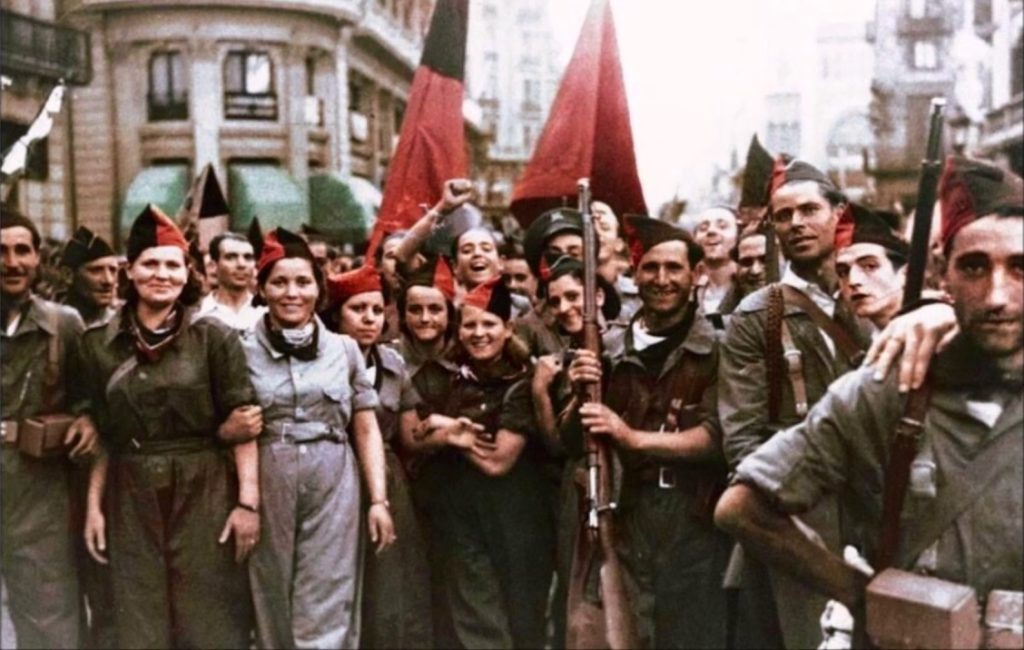
Twenty-six-year-old Italian Antoine Gimenez was one of those caught up in the events of Spain from the outbreak of turmoil in July 1936.  He was part of a wave of “anti-militarists, revolutionaries, Jews, exiles, escapees, everyone who knew persecution by the state,” according to Dolors Marín Silvestre in the book’s foreword, who “flooded into Spain to drink in what it was like to live like fully fledged men and women.”
Because unlike the International Volunteers — predominantly filtered through socialist and communist organizations — who came to fight fascism, these early international participants were drawn to the Spanish conflict for the promise of a new society as a social revolution began to take hold on the republican side of the Civil War.

“In 1936 I was what is conventionally referred to nowadays as a ‘marginal’: someone living on the edge of society and of the penal code,” writes Gimenez. “My sole concern was living and tearing down the established structure. It was in Pina de Ebro [on the Aragon Front] and seeing the collective organized there and listening to talks given by some of the comrades, by chipping into my friends’ conversations, that my consciousness, hibernating since my departure from Italy, was reawakened.”
Antoines’ is an exhilarating and somewhat swashbuckling tale. He was working as a migrant field laborer near Barcelona on the day of the military coup d’etat, July 18, 1936. He immediately joined the tide of Catalan workers and peasants mobilizing to oppose the fascist outbreak and days later is witness to the liberation of the town of Lérida under the auspices of the anarchist Confederación Nacional del Trabajo, (National Confederation of Labour; CNT).

Antoine never feels the need to elaborate on why he throws himself body and spirit into the Spanish cause. “I considered myself an anarchist,” he writes, as if that explains everything. What’s left unsaid, conversely, tells us more about the man.

The reader is treated to a ringside seat of what it is like to be caught up in the maelstrom of a revolution in progress. The Falange (fascist) militia is chased out of town, the armory is looted, priests are summarily executed, jails are opened, and young interred women are released from the monastery. Pandemonium is unleashed upon the streets, and revenge is extracted for generations of subjugation and abuse. In the wake of the initial excesses, “the unions and other revolutionary organizations quickly accepted their responsibilities, and order was completely restored.” Antoine strolls around, euphoric, “watching these people, intoxicated by newfound freedom, trying to build society on new foundations.”

So began the giddy work of redistributing the lands of the fleeing great landlords to impoverished peasants. Popular Committees were set up to organize collectives to take over the provision of essential supplies not just for the population but also for the fighters on the Aragon Front. These were the nuts and bolts of the revolution occurring behind the front lines during the early days of the Civil War, and what appealed so much to Gimenez and his ilk. His enthusiasm is such that, some days later, when the local CNT spontaneously organized a militia to go to the front-lines to repel Franco’s advancing army, he simply jumps on the back of one of the trucks and heads off into war.
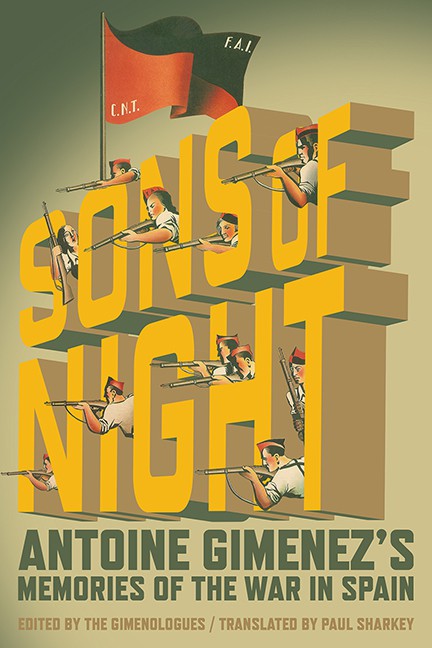

Gimenez’s memoir does a good job of capturing the spontaneous and hope-filled mood of the times. The hastily assembled CNT workers’ convoy joined forces with the Durruti Column and trundled off to the Aragon Front to confront the well-trained, professional rebel army. But as everyone knows, it didn’t end well. Despite its passion and enthusiasm, the Column — led by the legendary anarchist Buenaventura Durruti — was eventually destroyed by the enemy with its overpowering aerial superiority in the form of the Nazi Condor Legion, sent by Hitler to support his Spanish allies.

Obviously, Antoine survives to tell the tale, but the manner of his survival is remarkable. Time and again, he escapes skirmishes and ambushes by luck or guile. His unit — the International Group of the Durruti Column, informally known as Sons of Night due to their guerrilla prowess — operated somewhat independently of the main body of the Durruti Column to good effect. But after many successful guerrilla raids behind enemy lines, their good luck runs out on October 16th, 1936. The unit falls into a trap and is surrounded in the village of Perdiguera along the fluid Aragon front-line. Fifty internationals, both men and women, representing a dozen nations, are killed by the advancing Francoist lines, thousands-strong. Somehow Antoine manages to retreat unscathed, apart from being grazed by bullets leaving holes in his sleeve and trousers.

Antoine is the lone survivor of his quixotic international group. It is a jarring moment. Almost everyone we have been introduced to up to this point is now dead.

At times, Sons of Night reads like Ernest Hemingway’s famous Spanish novel For Whom the Bell Tolls, except this of course is memoir, not fiction. If Gimenez’s tales seem too incredible to be entirely true, the book features an extensive and exhaustive historiography that backs up, as far as possible, all his claims. Inspired by Gimenez’s memoirs (originally written in 1972, but unpublished for two decades), an amateur group of historians (calling themselves “The Gimenologues” in honor of the writer, who died in 1982) decided to conduct a rigorous investigation of the events and context of the memoir.
The Gimenologues notes and appendices take up over half the volume and are in themselves a fascinating and illuminating read. For example, they follow the trail of another international volunteer attached to the Sons of Night group, a French woman known as Mimosa (Georgette Kokoczynski). Antoine clearly has a thing for his fellow revolutionary and describes Mimosa as an engaged and dynamic volunteer who “loved living, loving and laughter.”

Minosa’s own account in her previously unpublished diary unearthed by the Gimenologues, portrays a vastly different image – of a woman torn apart by doubt and deeply unhappy with the situation in Spain. “This civil war is a mistake on both sides. But who will dare admit it?” she writes. “In both camps, it is kill, kill, and life is worth no more than an insect.” She and Antoine have an affair on the front-lines that leaves, at least Antoine, all starry-eyed and poetic. It doesn’t even register an entry into Mimosa’s seething diary: “All the dregs make up our column. I believe I have seen what I believe to be the scum of the earth.” One hopes she is not including Antoine in this description.

Mimosa is slain at the battle of Perdiguera. Antoine stumbles across her bloodied, naked body tossed in a ditch. Franco’s soldiers had slashed her belly open, leaving her entrails “spilling from gaping wounds exposed to the sun.” To Antoine’s horror, he realizes that she is still somehow clinging to life. “I wanted to vomit. I thought I was losing my mind,” he writes. “Somebody pulled me away… I watched him shoulder his rifle, then heard gunshots. It was over. I was crying.”

Historians often refer to the Spanish War as “the last great cause,” and Gimenez’s memoir certainly fits into this framing. More fitting perhaps is Albert Camus’ observation that through the defeat of the Republican side “we learned that one can be right and yet be beaten, that force can vanquish spirit, and that there are times when courage is not rewarded.”

Early in the book, Antoine tells the story of a young peasant woman called Juanita, whom he met in Lérida in the heady days of revolution when the political order was being turned upside down and the workers and peasants were taking control. Juanita threw herself exuberantly into the thick of things, participating in the meetings and activities of the new collectives, unleashing all kinds of previously untapped potential and capacity. She and Antoine found each other in the fire of the popular uprising. They kissed one last time as he clambered aboard the militia truck heading off to the Aragon Front. In a kinder world, maybe something could have come of their tantalizing encounter. Instead she would perish a short time later “under strafing by Francoist planes while out in the fields with some other comrades gathering the remaining sheaves of wheat.”

After 730 exciting, charming, frustrating and tragic pages, Sons of Night serves as a long paean to remind us that being brave and resilient, and on the right side of history, is sometimes, devastatingly, not always enough.


Book Review – The Overstory by Richard Powers (2018)
The Overstory – Richard Powers – Lizzy's Literary Life

 
I don’t read much fiction. In these dark times, or perhaps since Trump and a world defined by crisis,
it seems necessary, urgent even, to keep fully informed, to try to understand why things are
happening from global conflict to climate change and to follow the science as much as the narrative.
Reading fiction can seem a luxury, or a cop out, akin to a position George Orwell described in his
famous 1940 essay, Inside the Whale, oblivious to the storm all around.


So when as eminent and engaged social commentator as Naomi Klein strongly recommends a work
of fiction, it is wise to take heed. “Richard Powers’s novel, The Overstory […] has been incredibly
important to me,” Klein told the Guardian in a September 2019 interview. “It’s rare, in good fiction,
to valorise activism, to treat it with real respect, failures and all, to acknowledge the heroism of the
people who put their bodies on the line.”


This remarkable book, however, is not so much about political activists or campaigning, but a story
about trees. Or specifically, about how networks of trees bind together, and what we humans can
learn from them. 

It is a dense book, heavy with what one could call plant biologist or dendrologist jargon.
Nevertheless, the premise of the book is straight-forwardly summated early on by one of the
characters – an environmental enthusiast – when he says “We know so little about how trees grow.
Almost nothing about how they bloom and branch and shed and cure themselves. We’ve learned a
little about a few of them, in isolation. …But nothing is less isolated and more social than a tree.”


The opening chapters are like a series of short stories, spread over time and place, loosely bound by
the theme of human interaction with the world of trees. Some of the narratives are engaging, others
not so. The family saga behind the story of a huge chestnut tree on a farm in Ohio that survived the
chestnut tree blight (some 2 billion trees lost in a generation) is gripping. But the tale of the
squabbles of an American suburban family planting specific trees for each of the kids to match their
character fails to grip the imagination.


However, one of the family members, a teenage savant who reads like a cross between Lisa Simpson
and Greta Thunberg, captures the spirit of the novel with her lament that “real joy consists of
knowing that human wisdom counts less than the shimmer of beeches in a breeze. As certain as the
weather coming from the west, the things people know for sure will change.”


Two of the multiple narratives come to prominence – the first about a US pilot in Vietnam left
dangling in a tree after parachuting from his plane, and the second about a pot-smoking college
student in Michigan who in the wake of a near-death experience, decides to devote her life to eco-
activism. The two meet up on the north east coast of the US and find themselves embroiled in a
protracted fight to protect the old-growth Redwood forests of the Cascadian area.


Eventually all the characters of the various plot strands find themselves here in one capacity or
another, and the final third of the book really takes off from this point. Love and fate coincide in an
epic struggle to defend the ancient forests from wanton destruction.


The Overstory is immersed in the naturalist tradition of American literature, walking in the steps of
Walt Whitman and Henry David Thoreau, and its context is the great, vast, seemingly limitless nature
that makes up much of the North America continent. Richard Power’s prose is dense and at times
the reader will be grabbing for the dictionary to understand what is being described. “It’s the
grooved, Doric perfection of the red-brown columns, shooting up from the shoulder-high ferns and
moss-swarmed floor – straight up like a russet, leathery apotheosis.” This kind of prose can be hit or
miss – sometimes it reads beautifully, and other times it can be painfully overwrought.

At a hefty 502 pages, the novel seems to drag in parts, particularly around its mid-section. Occasionally -- and I would have to apologise profusely to Naomi Klein for this abomination -- I found myself skim
reading. In its attempts to fit into the tradition of the Great American Novel, The Overstory perhaps
overshoots in its employment of minutiae, not only in describing the grand natural world of the
continent but also the detritus of American family life.


The Overstory won the Pulitzer Prize for Fiction in 2019 and is undoubtedly a powerful and enduring
work of prose fiction around the most pressing issue of our times. To paraphrase Brecht’s much-
used dictum: will there be fiction in the dark times? Yes there will. There will be fiction about the
dark times.


However, because of its tendency towards overt navel-gazing American exceptionalism, I fear this
reader will stick to non-fiction for the time being.

References

We have a once-in-century chance: Naomi Klein on how we can fight the climate crisis
https://www.theguardian.com/books/2019/sep/14/crisis-talk-green-new-deal-naomi-klein
In the dark times, Will there also be singing?
https://gerryco23.wordpress.com/2016/12/31/in-the-dark-times-will-there-also-be-singing/
Craig, Thomas: Sustainability and the American Naturalist Tradition
https://cup.columbia.edu/book/sustainability-and-the-american-naturalist-


Policing the Planet

 teleSUR  Opinion & Articles

Anatomy of a Neoliberal Racist Killing Machine

By: Ramor Ryan
Published 28 July 2016 

A new book shows how aggressive policing tactics exacerbates structural racism and leads to more violence against marginalized communities.
“Policing the Planet” begins with the story of Eric Garner, a Black man killed by New York City police in 2014 in an incident arising from a small-scale infraction involving the sale of loose cigarettes. The book could just as easily begin with the story of Alton Sterling, shot dead by police last week as he went about his business of selling CDs on the street in Baton Rouge. Both men have joined what is described in “Policing the Planet” as “the morbidly expanding rollcall of the racialized poor killed by police and vigilante violence.”
The book makes a direct connection between these all too frequent killings and evolving police strategy. The application of the so-called broken windows policing theory—a zero-tolerance, invasive form of street policing—has increased police power, and leads to the criminalization of whole sections of the population—specifically the poor, Black and homeless communities.
In a collection of essays from leading scholars, activists, social movement organizers, and journalists, “Policing the Planet: Why the Policing Crisis Led to Black Lives Matter” attempts to “intervene in urgent public debates about structural racism, policing, and urban uprisings in the neoliberal present.”

It shows how the aggressive policing tactics inherent in broken windows exacerbates structural racism and leads to more violence against marginalized communities.
And in the face of this form of punitive, racially biased policing, Black lives do not seem to matter.

Shifting Strategies
The book considers the ramifications of a shift in policing strategy in response to the social crises of the 1960s and 1970s. The new strategies sought to move away from mass incarceration and toward a less brutal form of social control premised in community policing. The focus shifted from serious crime to “disorder,” because disorder—things like broken windows—leads to a greater climate of crime. Clean up the small stuff, goes the theory, and there will be less crime in general, including serious crime.
Broken windows policing was prominently established in New York City under Police Commissioner William Bratton during the 1990s. In practice, it meant more cops on the street busting people for previously overlooked misdemeanors like fare evasion on the subway, carrying open alcohol containers, and hawking goods on the sidewalk.

Bratton certainly got results in terms of “cleaning up the streets,” but as Alex Vitale explains in “The Emergence of Command and Control Policing in Neoliberal New York”—one of the books’ seminal essays—the result was the dramatically expanded role of police in the everyday lives of certain marginalized communities such as of young people of color, homeless people, street vendors, and sex workers.
Broken windows, explains Vitale, “has become a system to micromanage these populations, not through the constant brutality that characterized earlier methods of policing the poor, but through more subtle but invasive tactics of creating hundreds of thousands of additional contacts between the police and the policed and dramatically expanding the number of people churned through the criminal justice system even if for only short periods of time.”

Rather than a substitute to mass incarceration, broken windows serves—as pointed out by the editors in the Introduction—as a “robust supplement to it,” adding collective punishments to communities already under siege. Vitale argues that the NYPD’s core policing strategies moved emphasis from “using extensive imprisonment as the primary tool of punitive social control towards the intense regulation of low income communities of color as prison like spaces themselves.” 

Globalization
Despite fierce criticism, the broken windows doctrine has been lauded as a success by advocates who see it as an effective remedy against urban lawlessness, serving to quell public fear of crime and restore order to fraying communities. Tracing the global spread of the broken windows policing strategy, “Policing the Planet” notes that “from New York to Baltimore, Los Angeles, London, San Juan, San Salvador, and beyond, Bratton’s model has become a neoliberal urban strategy practiced and adapted worldwide 
The reason for its popularity among police departments globally is alluded to by Arun Kundnani in “Total Policing and the Global Surveillance Empire.” He explains how the U.S. is seen as “almost the definition of innovation in policing, so there has been an almost constant stream of imports from the U.S. to Britain,” and evidently, around the globe. He asserts that the roots of these policing strategies are found in counterinsurgency campaigns employed globally by imperialist forces.
This manifests itself on the ground with deadly and divisive consequences. Marisol LeBron outlines how Puerto Rican officials, in response to the breakdown in social order due to neoliberal economic policies, “turned to policing in an effort to maintain ‘order’ and manage populations rendered redundant, and therefore, dangerous, within racial and capitalist systems of value.”

The resultant mano dura (iron fist) policing reduced general levels of crime but saw homicide rates soaring to unprecedented levels. LeBron concludes that the implementation of these strategies has “rendered certain (low-income and racialized) populations vulnerable to premature death through logics and practices of dehumanization and criminalization.”

'Protesting Profound Austerity'
 This deadly dehumanization and criminalization of “redundant” sectors of society is implicit in the killings of Eric Garner and Alton Sterling. They form part of the morbid roll call of racialized poor killed by the police that has given rise to the powerful protest movement, Black Lives Matter.

#BlackLivesMatter exploded into national and international consciousness in the wake of the Ferguson uprising prompted by the 2014 death of Micheal Brown in Ferguson, Missouri. A decentralized, horizontal social movement organized in autonomous chapters around the country, Black Lives Matter has brought multitudes of people out onto the street in response to police killings. “And in this powerful new movement,” says one of its founders Patrisse Cullors, “we are seeing some of the most vibrant, creative responses to state violence.” 

Indeed, the impact of the social movement is such that Ruth Wilson Gilmore can assert that “post-Ferguson, the #BlackLivesMatter uprisings and broad-based organizing have pushed some aspects of US policing to the brink of a legitimacy crisis.”

In her essay, “Beyond Bratton”—a brilliant and erudite contribution to the volume—Wilson Gilmore explains how Black Lives Matter seek to turn criminal problems back into social issues: “Sparked by police murder, in the context of racial capitalism’s neoliberal turn, the post-Ferguson movement may therefore be understood as protests against profound austerity and the iron fist necessary to impose it”

It is in this context that editors Jordan Camp and Christina Heatherton place “Policing the Planet:”
“Rather than asking how the police can kill less, (protesters) have forced a broader set of questions: why have the police been endowed with the arbitrary capacity to regulate the lives of the racialized poor in US cities? Why do they have expanding and unfettered access to the bodies of poor people in general and poor people of color routinely? How and why are poor people criminalized for occupying public space?”

Crisis of Legitimacy
“Policing the Planet” is an important intervention to a key issue at a crucial time. It is not just critics of the police who speak of a crisis of legitimacy. Police commissioner William Bratton himself spoke in the wake of Eric Garner’s death and the spontaneous demonstrations that rocked the streets across the U.S.
“Let’s face it, we’re in a crisis at this time, in this country, on issues of race, around effectiveness of policing, around police tactics, probably the most significant I’ve seen since I joined policing in 1970,” said Bratton.
One thing is certain, as “Policing the Planet” points out: the present policing arrangements will not go unchallenged, nor remain as they are. The pressure from below can force police reform or the mano dura may be reinforced from above.

Black Lives Matter co-founder Patrisse Cullors has a clear idea of what is to be done.
“I think we need to have a movement around divestment—to divest from police and prisons and surveillance and to use that money to reinvest in the communities that are most directly impacted by poverty and the violence of poverty,” said Cullors.

Ramor Ryan is author of Zapatista Spring (AK Press 2011) and Clandestines: The Pirate Journals of an Irish Exile (AK Press 2006).

A History of Violence

By: Ramor Ryan 
teleSUR, May 2016
 
The U.S.-driven war on drugs has been ineffective and counterproductive, and in his new book “A History of Violence,” journalist Óscar Martínez shines a light on some of the more devastating consequences of this policy failure in his native El Salvador and surrounding Central American countries.

His previous work, the much-acclaimed “The Beast: Riding the Rails and Dodging Narcos on the Migrant Trail” (2013) focused on the dangerous migrant trail of the huge numbers fleeing appalling conditions in Honduras, Guatemala, El Salvador and to a lesser extent, Nicaragua. In this latest work, the author goes some way in answering the question why these people are compelled to flee.
“I want you to understand what thousands of Central Americans are forced to live through,” writes Martínez, who goes on to present a portrait of “this terrifying little corner of the world” ravaged by war, economically ruined and now overrun by powerful and ultra-violent drug gangs.
“Everything that happens to us is tangled up with the United States,” explains Martínez.

Prior to 1980, the rate of migration from Central America to the U.S. was very small. Then a series of internecine wars in the region – exasperated by “certain American politicians who tried to settle the Cold War in this small part of the world” – lead to the first massive wave of fleeing refugees. The Reagan administration sent millions in military aid to prop up deeply unpopular and repressive governments against left-wing insurgencies and in the process, devastated local economies and structures of society.

The levels of violence subsided in the 1990s with the onset of protracted peace processes, but a new threat engulfed the northern triangle of Central America as international drug cartels moved in to secure transshipment routes. Within a couple of decades, the region went from Cold War theater to a corridor for narco-trafficking, with 90 percent of cocaine consumed in the U.S. passing through the region.

The impact of the passage of illicit drugs – about 850 tons a year, reports Martínez – through these impoverished nations has been devastating. With massive profits to be made by independent contractors in securing the transport of the goods, local criminal groups, with the connivance of government and judicial elements, fight it out between themselves to secure the illicit routes.
It is all about profit, and the local narco’s business in Central America is to push consignments north to the Mexican border, where Mexican cartels will take over. A kilo of cocaine in Nicaragua, Martínez reports, “is worth $6,000; in El Salvador that same kilo is worth $11,000, in Guatemala is goes up to $12,000, and then in Chiapas (southern Mexico) it’s at $15,000 and by the time it gets to Matamoros (on the U.S.-Mexico border) it is already up to $20,000.” At each hub along the route, big profits can be made, and thus, control of the territory is viciously contested. The victor is most likely the best-armed, most brutal competitor.

It is a devil’s concoction as huge multinational Colombian and Mexican cartels intersect with ferocious local gangs known as Maras – imported from Los Angeles in the ‘90s – and the already established criminal fraternity – smugglers, traffickers, drug dealers, and a wide range of crooked cops, judges and politicians. As Martínez shows, the legal system is utterly unable to cope with the enormity of the problem, and the medieval-like prison system is nothing more than an overflowing academy for developing more ruthless gang-bangers to perpetuate the violence.

Incredibly, the current level of violence in the region – in most part generated by the narco-trade and its spinoffs – at times exceeds that of war time. For instance, during the Civil War in El Salvador, the daily death rate reached 16, while during September 2015, the author reports, the murder rate of 23 each day.
It is a perfect storm of impoverished post-war states, overseen by corrupt governments and judiciary, teeming with criminal organizations and street gangs all battling it out for a slice of the lucrative U.S. drug trade.
Into this murderous cauldron of narco-capitalism steps the fearless Salvadoran journalist Óscar Martínez with a mission to uncover the truth and expose the culprits. He bravely goes to the source of the stories, speaks to the people on the ground, and in the process, upsets both ruthless criminals and corrupt authorities.

Frontline Reporting
 
“A History of Violence” presents 14 overlapping journalistic pieces that take the reporter into the murky depths of the drug trade, the cartels, the gangs and linked industries like human trafficking. He visits police precincts, jungle outposts, urban prisons and squatter camps.

He meets a whistle-blowing city official in a fast food chicken joint, and a retired human trafficker on his ranch. He interviews a woman who was sold as a sex slave and a man who was kidnapped and forced to act as a mule for drug consignments over the U.S. border. He peers down an abandoned shaft full of corpses that will never be excavated. He is there to witness a community of incredibly poor Salvadorans driven out of their humble houses by marauding Mara gangs. And he is there when the police official comes along, not to protect the citizens from the attack, but to tell them to get down on their knees and pray.
A History of Violence constantly takes the reader to the most abject and poignant places to meet sometimes decent, sometimes vile characters.
One recurring character is a hardcore gangster called The Hollywood Kid – with a reputed 54 murders under his belt – who has turned state witness and is in a witness protection program of sorts. The Salvadoran police, without a budget to sustain the informer, consign him to a rural outpost, locked up and starving in a sweltering room above the septic tank.

It is a tale of a death foretold. Martínez is there at the grim end. The investigative reporter writes with typical pathos as he relates the proceedings around the funeral.  

“The wake was modest. About thirty people, friends of The Hollywood Kid’s mother sang evangelical hymns ... [She] sat slumped and defeated in a plastic chair next to the coffin. She didn’t cry. It wasn’t a first for her. In 2007 the Maras had killed her other son, Cheje … The Hollywood Kid’s widow was breast-feeding in the corner.”

Martínez constantly allows the reader these kinds of intimate glimpses into the protagonist’s lives. The Hollywood Kid was a murderous gangster, but he was some mother’s son. He grew up, as his bereft son will, imagining a different life.

Righteous Indignation

“A History of Violence” is not simply about storytelling, and despite the gruesome subject matter, is certainly not sensationalist journalism.  
Óscar Martínez is a passionately engaged reporter who goes under the surface to get to the truth. See how he fiercely divides the book into three sections – Emptiness (or the absence or disinterest of the state); Madness (what is festering in the emptiness); and Fleeing (the only option for many desperate people).

Martínez is incensed by the action (or inaction) of the powers that be and the abysmal failure of drugs policy. “I think that the model of combatting drugs is absolutely absurd,” he said in a recent interview. “It’s already been shown that prohibition is ridiculous. It’s already shown that criminalization is a loss for the state.”

He takes sides – with the dispossessed, the powerless, the victims of the wanton violence and the multitudes forced to flee in order to stay alive.

And with his colleagues at El Faro, the groundbreaking investigative Central American online magazine based in El Salvador, he names names, and unsettles the cabal of people getting rich from all this human misery.  

“I continue to believe that the journalism that I do, the journalism that we do at El Faro,” he says, “makes life a little more difficult for a few bastards.”

Ireland: The Uncomfortable Dead of Easter 1916

Ireland’s Official Easter Rising commemoration sheds light on 100 years of inequality and failed expectations.

Dublin was in lockdown on March 27th as the Easter Sunday State Commemoration was held to mark the centenary of the 1916 Rising. Surrounded by an extensive ring of steel, 5,000 state dignitaries and invited VIPs witnessed an extravagant ceremony in front of the historic site of the General Post Office--The GPO—ground zero of the insurrection one hundred years ago.

Beyond the closed-off main thoroughfares, thousands of onlookers –predominantly tourists-- strained to catch a glimpse of the activities. If watching a small country’s drab army and fire brigade march by is your thing, you would have loved this. Spectator numbers fell dramatically short of the organizers expected 250,000. 


On a crowded side street, away the official events and television cameras, The Homeless Families of Ireland organization held a protest, raising a voice in particular for the 1,800 homeless children in the state. Invoking the Proclamation read by the rebels on the steps of the GPO in 1916, the homeless spokeswoman appealed for “all the children to be cherished equally.”
“On this day, we ask that we not only celebrate the rebels with flowers and speeches, but we commit ourselves to achieving their vision of creating a Republic of equals, by solving the homeless crisis which shames our nation today.”   

Reflecting the disparity within an increasingly two-tiered society, the two concurrent events were a stark reminder of the growing divide within the affluent Irish state between the haves and the have-nots. 


Revolutions Never Turn Out as Planned
The Easter Rising of 1916 was a pivotal historical moment not just for Ireland, but for colonized peoples all over the globe. The British Empire was at that time the most formidable power in history, controlling one fifth of the world’s population. Edward Said saw the Irish rebellion as a “model of twentieth-century wars of liberation”.
The courageous--but doomed-- act to rise up against the global power by a few hundred rebels set an example, and inspired others. Anti-colonial rebels from India to Africa took note. Before the Russian Revolution the following year, Lenin hailed the Irish insurrection as “a decisive blow against the British Empire.” Yet it appeared a more significant political event abroad than in Ireland. 
The Rising occurred during a period of global unrest and revolutionary fervor. The 1916 generation were an enlightened mix of anti-imperialists, fenians, socialists, syndicalists, feminists, secularists and-- of course-- writers, poets and artists illumined by the rebellious zeitgeist of the age. 
The insurrection created a revolutionary moment filled with great potential: suddenly a different Ireland was not only possible but being created in the here and now. 
The tragedy of 1916 is that the revolutionary vision of the Proclamation--to change everything-- was defeated within a few short years by counter-revolutionaries emerging from within the nationalists’ ranks.
In the wake of the War of Independence and the Civil War, conservative nationalists working closely with the Catholic Church created an authoritarian and patriarchal statelet that did not differ greatly from the status quo before the rising. Notions of social justice and equality were put on the backburner. The revolutionary generation of 1916 was shoved aside; women were told to return to the kitchen. 
The dreams and ideals of 1916 were not realized, and the revolutionary impulse of the generation was lost. There are consequences when a great historical moment like the Easter Rising provides such a mediocre outcome. For Ireland, it meant 100 years of underachieving, where progressive change came slowly and only through the tireless efforts of grassroots initiatives. 

The Uncomfortable Dead
The Irish state was always uncomfortable with the notion of celebrating the Easter Rising. The 75th anniversary in 1991 was a mute affair, only really commemorated by marginalized republicans. The centenary presented a dilemma – how to commemorate a revolution when it is still unfinished business, and faced with a sizeable portion of the population deeply unhappy with the current government – some militantly so.
The solution was to make it a huge media spectacle, stripped of political currency, re-branding 1916 as a marketable commodity for tourists to consume. 

The first act was to change the date of the anniversary. Why commemorate the Rising on March 27th, almost a month before the actual anniversary of April 24th? 

Journalist Gene Kerrigan commented, “Why not hold it on the anniversary? Well, due to the lunar and solar cycles and a formula initiated by the Council of Nicaea in 325AD, this year Easter is within 10 days of St Patrick's Day. This created an accumulation of tourism potential, between March 17 and March 27, that the Government couldn't resist…So, yet again fumbling in the greasy till, it's brought the gig forward by a month, to boost the hotel and catering trade. We're celebrating the 99 years and 11 months anniversary of the Rising.”


With a reputed €45 million budget, the state has gone into overdrive, saturating the country with everything 1916. 1,800 or so commemorative events were scheduled – free talks, exhibitions, debates, film, performances and dramatizations; every form of media is swamped with anniversary content. Dublin is awash with centenary fervor, from theatrical reenactments in the streets to buses converted to Easter Rising tours. Buildings are draped with enormous banners representing different figures of the era, including notorious anti-insurgent political leader John Redmond, who described the Rising as a “wicked and insane” event.
While the celebrations are undoubtedly popular, the overflow of media coverage serves another purpose. With its multitude of interpretations coming from every historical, cultural, and political perspective, radical voices are marginalized, and the ideology of the Rising is dispersed through the cacophony of voices. And in the process, the meaning of the Rising is recuperated by the state. 
Many are boycotting the official commemorations and holding a Citizens' Centenary Commemoration on April 24th, the actual date of the centenary. 

Another Easter Rising 

Yeats’ mesmerizing words have long been employed in the service of official Ireland, and his Easter 1916 poem has been rolled out ubiquitously this month - All changed, changed utterly: A terrible beauty is born.

But change has come too slowly since 1916 and the aspirations of the 1916 generation remain so; most of all for the sizable portion of the population that is excluded from the wealth of the nation: The homeless, the marginalized, those forced to emigrate, the 138,000 children living in poverty. 

On a side street in Dublin, the homeless are protesting the rising shame of Ireland’s growing inequality. These are the excluded, those from below. Official Ireland has no place for them.

For them, another of Yeats’ famous lines serves better – perhaps it is time once more to “hurl the little streets upon the great”.

Paid Off in Passion: The Life Lessons of John Ross’s Rebel Reporting

  Rebel Reporting: John Ross Speaks to Independent Journalists, Edited by Cristalyne Bell and Norman Stockwell. Hamilton Books, 2016

There is an amusing exchange between legendary journalists Studs Terkel and Hunter S. Thompson during a celebrated 1973 radio interview. Terkel comments on the notoriety of the Fear and Loathing in Las Vegas author.
I just thought of a phrase for you - a disturber, you are a disturber, and that is probably what a journalist should be all about.” 

Thompson quips back: “A lot of people are very insulted by my kind of journalism. But I am insulted by some of their stuff too…”

John Ross is of this ilk, this is his constituency. A little bit of Terkel’s folksy bard of the people storytelling, and a lot of Thompson’s gonzo-style frontline reporting. And in Rebel Reporting, Ross enters into the realm of academia to pontificate on journalism to a class of students, and lecture them on how most everything they know about the craft is wrong. John Ross, a disturber? Certainly! 

Pearls of Useless Advice
John Ross worked as a freelance journalist for 50 years, right up to his death in 2011, wrote ten volumes of fiction and non-fiction and penned numerous books of poetry. Rebel Reporting is a posthumously published series of lectures first delivered at San Francisco‘s New College in 2006, and quite unlike anything previously produced by Ross. To call them lectures is probably a misnomer – in reality they are a series of provocations, or incitements.

“Now we come to the part where I emit pearls of useless advice,” he tells the no doubt bewildered students, “Useless because you have to live this stuff to know it.” Indeed his empiricist philosophy makes for a remarkable and stirring series of interventions, a tour-de-force encompassing anecdotes and storytelling, interspersed with a medley of his inimitable beat poetry.

At root, Ross’s Rebel Reporting is a passionate plea -- a howl-- against conformity and complacency and an unrelenting attack on formal journalism as represented by J-School.

“Avoid J-School like a poison,” he counsels. “J-School teaches you how to lie for a living, how to sell your skills to transnational media consortiums for an ounce of flesh. J-School teaches you how to promote class oppression, consumerism, racism. How to justify genocide and the destruction of the planet. The status quo.”
Don’t hold back, John. Tell us how you really feel.
“J-Schoolers are not reporters.” he rages, “—they are careerists. J-School teaches you how your career is so much more important than speaking truth to power.”

John Ross is all about speaking truth to power. This is why the series is entitled Rebel Reporting, invoking his own book Rebellion from the Roots (1994), about the Zapatista uprising in Chiapas. For Ross, journalism is not a profession but a moral responsibility. “The first thing you need to know is that you do not have a career in journalism. Forget about your career. You have an obligation—to tell the story of those who entrust you with theirs, to tell the truth about the way the world works.”

He delivers his talks like a poetry slam, his sentences read like melodic progressions and he habitually employs repetition to craft rhythmic cadences. “Rebel reporters are storytellers. Rebel reporters are poets. Rebel reporters are travel writers.”

His journalism is a world of freewheeling bards, not desk-bound hacks churning out fillers between the adverts. His reporters are vitally active participants in society at large: “Rebel reporters are all Joe Hills, trouble-making troubadours moving from town to town singing out the news in public plazas. The emphasis is on singing here.Rebel reporters put the music in the news.”

Ross was an engaging public speaker – a skill honed as a tenant organizer in San Francisco in the 1960s, even running for public office as supervisor – and this volume captures the essence and vigor of John Ross speaking live. All that is absent on the page is his signature self-effacing charm, as well as his stoical gait – a rough and tumble life had left him marked and visually impaired; he inevitably crouched closely to peer over bunches of papers. 

Rebel Partisan
Having impressed upon the students the potential folly of pursuing a journalistic career, what alternatives does he proffer?

For John Ross, nothing less than total emersion is enough. Reporting is a way of life, not a job, and intrinsic to that is taking sides – on the side of truth and against power. A good reporter is a partisan who, he asserts, “makes people angry, encourages organization, offers them hope that another world is possible. A good rebel reporter is a participant in rebellion, or resistance or revolution or whatever you call the struggle for social change.”  

Good rebel journalism incites rebellion, he declares. These are no idle words and Ross’s lectures begin with one reporter languishing in jail for withholding sources, and ends with the death of another, shot down in the line of action. The stakes are raised and the role of the reporter is magnified. 

Risk -- both personal and economic -- is inherent in Ross’s proposition to reject J-School and eschew a formal career. In this sense, Rebel Reporting reads like a manifesto for freelance precarity, a double-edged sword at once righteous and perilous. Ross describes it thus: “I am free to choose what words to use, and also free to sleep under bridges and lose all my teeth.”

Clearly for him, the wager is worth it, and the fruit of the labor is serving the people. “The coin of our realm is passion,” he writes, beautifully. It is worth quoting this passage in full:
While corporate journalists bask in the bland neutrality of their vaunted “objectivity,” dabbling in a language drained of all outrage for fear of damaging their career track, rebel reporters, who know only too well they have no careers but rather a responsibility, are paid off in passion —passion for language, passion for telling the story with passion, passion for struggle and change, for sharing spirit, solidarity.

Handing it Down
Ross titles his series of talks “Handing it Down”, and in four installments explores various angles of rebel reporting - from how to cover global resistance movements (embed with them), to how to be an Anti-War Correspondent (never embed with them).

Ross’s mantra is “ir a lugar del los hechos,” go where the story is, and this he does with some prolificacy, managing to place himself on the frontlines of countless rebellions around the Americas and as far afield as Baghdad.
He covers the use and abuse of language, and ostensibly, gives advice to students on how to document injustices and pitch stories -- although he has already made it clear that all this can really only be learned in practice by doing.

What he is actually “handing down” are a series of musings on his life work, serving as a kind of pep talk and motivator for activists already engaged in the field of rebel reporting - his ‘community.’ John Ross, in his wisdom, has left us a somewhat reflective, somewhat instructional document outlining what it is to be a rebel reporter, what he has learnt from experience and mistake, and how to go about it with integrity.

Some might say his is a dying breed of on-the-road reporter, with pencil and pad churning out stories for disappearing newspaper outlets. Certainly some elements of John Ross’s repertoire have become superannuated through technology, but the rebellious impulse remains as prevalent as ever. Rebel reporting is thriving, and is everywhere evident in decentralized, dispersed and autonomous media networks online and in print.  

The spirit of John Ross lives, and one similarly courageous reporter immediately springs to mind. In terms of speaking truth to power, Barrett Brown’s reporting for The Intercept is exemplary. Although somewhat unfortunately hostage to the concept of ‘ir a lugar de los hechos,’ Barrett’s prison writings are subversively acerbic and captivating. Good rebel journalism incites rebellion indeed, something the prison authorities have noted, resulting in Barrett’s frequent sojourns in the hole. 

Throughout the book, John Ross extolls us to follow in the footsteps of rebel reporter luminaries -- Joe Hill, Live like him! Brad Will, Live like him! He would undoubtedlyand unequivocallyhave added one more name: Barrett Brown – Live like him!

From National Liberation to Autonomy: The Trajectory of the PKK

teleSUR, December, 2015
Paul White’s new book, “The PKK – Coming Down from the Mountains,” is a useful critical analysis exploring the group’s history and ideological evolution.

This content was originally published by teleSUR at the following address: 
 "http://www.telesurtv.net/english/opinion/From-National-Liberation-to-Autonomy-The-Trajectory-of-the-PKK-20151202-0021.html". If you intend to use it, please cite the source and provide a link to the original article. www.teleSURtv.net/english
Paul White’s new book, “The PKK – Coming Down from the Mountains,” is a useful critical analysis exploring the group’s history and ideological evolution.

This content was originally published by teleSUR at the following address: 
 "http://www.telesurtv.net/english/opinion/From-National-Liberation-to-Autonomy-The-Trajectory-of-the-PKK-20151202-0021.html". If you intend to use it, please cite the source and provide a link to the original article. www.teleSURtv.net/english
Paul White’s new book, “The PKK – Coming Down from the Mountains,” is a useful critical analysis exploring the group’s history and ideological evolution.

Kurdish liberation forces have come to global attention as the front-line defenders in the heroic battle against the marauding Islamic State group threat on the ground in northern Syria. 

This content was originally published by teleSUR at the following address: 
 "http://www.telesurtv.net/english/opinion/From-National-Liberation-to-Autonomy-The-Trajectory-of-the-PKK-20151202-0021.html". If you intend to use it, please cite the source and provide a link to the original article. www.teleSURtv.net/english

The PKK - Coming Down from the Mountains
Paul White (Zed Books, 2015)
 Review by Ramor Ryan

Kurdish liberation forces have come to global attention as the front-line defenders in the heroic battle against the marauding ISIS threat on the ground in northern Syria. Hand in hand with beating back the advance of ISIS, the Syrian Kurds--organized in People’s Protection Units (YPG)--are also implementing a democratic revolution within the liberated territory of Rojava, part of the historic homeland of the Kurdish people.

 To better contextualize these rebels–currently supported by US-led coalition air strikes, and alsoa source of inspiration for leftists the world over--one must look beyond Syria into the greater Kurdish region, and at the YPG’s much-larger affiliate, the Kurdistan Workers’ Party (PKK).

 For almost four decades, the PKK have been at the forefront ofanational liberation struggle for an independent Kurdistan spanning the borders of Turkey, Iraq, Iran, and Syria. Denied statehood in the wake of WW1by colonial powers carving up the regional borders set by the Sykes-Picot agreement, the Kurds have been struggling for independence ever since. The current reinvigoration of the Kurdish issue can be attributed to the resurgent PKK, with a support base numbering millionsprimarily among Turkish Kurds and a formidable guerrilla wing based in the Qandilmountains, northern Iraq, (or in Kurdish eyes, southern Kurdistan).  

 In a geographical area convulsed by war, upheaval and competing local and global powers, the PKK and its affiliateshas emerged as a uniquely progressive movement, secular, left-wing and actively promotinggrassroots participatory democracy in its extensive zone of influence.

 They haven’t always been so. Paul White’s new book, The PKK – Coming Down from the Mountains is a timely and useful critical analysis, exploring thecomplicated, messy and bloody development of the organization, as well as charting its remarkable ideological evolution.In an “astonishing transformation”writes White, the PKK moved in two decades “from striving for an independent Marxist-Leninist Kurdistan to the current position of advocating ‘democratic confederalism’ by peaceful means”.

A History of Endurance

White offers an insightful history of the PKK organization from its founding in Turkey in 1978 by a small group of post-68 Marxist students and Kurdish nationalists, emerging out of “racist provocation, and Kurdish economic under-underdevelopment.” Like the history of the Kurds, the story of the PKK organization is one of endurance, existing under the constant threat of annihilation.Armed struggle was the tactic chosen by the rebels in the wake of the 1980 military coup in Turkey, launching their campaign in 1984 with guerrilla attacks on military targets.

 As the conflict escalated, the Turkish military employed overwhelming force to crush the rebels, and “a total of 32,000 PKK militants were killed and 14,000 captured between 1984 and 2008”, writes White. “Some 5560 civilians died and 6482 Turkish soldiers were killed during the same phase.” Hundreds of thousands of Kurds were displaced by the military in scorched earth policies, driving many into the arms of the PKK. The Turkish militaries’brutal counterinsurgency policies seemed only to fuel the insurgency, and by March 2013, a million Kurds were gathering in Diyarbakir, the de-facto Kurdish capital in the southeast, in support of the PKK.

 By this stage, the PKK had changed its strategy, and sought a negotiated solution for the conflict. The group’s leader, the charismatic and somewhat messianic Abdullah Öcalan – imprisoned by the Turkish state since 1999 – declared that “a new era is beginning and arms are silencing, politics are gaining momentum.”

 White, an academic, although sympathetic to the cause, has little sympathy for the PKK.  His previous work Primitive Rebels or Revolutionary Modernizers? The Kurdish Nationalist Movement in Turkey (Zed Books, 2000) provided a stinging critique of the PKK, particularly what the author saw as counterproductive Marxist-Leninist inspired armed struggle. White however, is enthused by the PKKs turnabout and sees it as a breakthroughtowardreal conflict resolution. Although the nascent peace process is “contradictory and perilous”, White believes that Turkish President Erdoğan has the will to back it, despite the threat from the Turkish‘deep state’ – a powerful cabal of military leaders and top government officials who have their own nationalist, even fascist agenda for the Turkish state.

 Democratic Confederalism


Alongside striving for a peaceful solution, the PKK have initiated a revolutionary process of participatory democracy on the ground in their zones of influence.

 White identifies the beginning of the transformation from “an orthodox guerrilla Marxist-Leninist group into an autonomist movement seekingdemocratic confederalism”withthe first PKK unilateral ceasefire in 1993. Recognizing that the armed struggle would not achieve the aimof an independent Kurdistan, the insurgent movement began to explore alternative ways of achieving Kurdish self-determination. After his imprisonment, Öcalandevelopeda non-statist ideology influenced by his reading of US social ecologist Murray Bookchin, advocating a self-managed autonomy with power based at community level.

 Putting theory into practice, the PKK set up an umbrella network in 2006 called the Kurdistan Communities Union (KCK), to implement a network of autonomous local councils and assemblies across Kurdish zones in Turkey, Iran, Syria and Iraq, as well as among the sizeable Kurdish diaspora in Europe.White describes how theKCK has “spread out to cities, towns, neighborhoods, streets, village organizations, communes and homes” as a movement organizing “to establish its own democracy, neither grounded on the existing nation-states nor seeing them as the obstacle”.Thus autonomy has taken hold to such an extent thatinmajor Kurdish provinces such asHakkâri and Şırnak“the people don’t accept the state authorities and two parallel authorities exist.” The Turkish state has responded by imprisoning some 8,000 KCK activists, an indication of how seriously it views the threat of autonomy.

 Intrinsic to the radical democracy of the autonomous model is equality for women, and Kurdish women have organized in the Free Women Unions (YJA) ensuring equal participation and representation within the assemblies of the KCKs. The female fighters taking on ISIS in Rojava have received much media attention, but women have long being central to the Kurdish struggle. White quotes independent reports stating that women constitute between a third and a half of PKK fighters. Rapperin Afrin, a commander of the PKKs Women’s Army, explains how “the women’s movement is the most dynamic part of the PKK. We are aware that without the liberation of women, a liberated society cannot be developed.”

 White also addresses the question of the leadership of Abdullah Öcalan. As the PKK transforms from an authoritarian and hierarchical structure to an autonomous, democratic movement, White outlines how Apo (Uncle, as he is known) has de-centralized the power structures of the movement, changing his role from absolute ruler to symbolic figurehead. Of course, being locked up in prison with his communication to the outside world mediated by his captors, realistically what other role can he play?  Nevertheless, he remains revered and, as White explains, assumes a more transcendental place in the struggle as a symbolic embodiment of Kurdish aspirations.  “Through their warm personal relationship with their serok (leader), his members and supporters have come to believe that they were already, in a sense, ‘liberated’ or at least ‘experiencing’ Kurdistan.”

 Coming Down from the Mountains

It is often repeated that the Kurds have no friends but the mountains, and in this work, White postulates that the PKKs’ current political initiative offers a real possibility of breaking that isolation. However, he recognizes that the recent rise of the Islamic State (ISIS) in the region destabilizes the peace process in Turkey. The Turkish government is seen as covertly supporting the Islamic State while the PKK has urged all Kurds to take up the fight against ISIS. In August 2014, the PKK was hailed for rescuing 20,000 Yezidis surrounded by ISIS in northern Iraq, and in the battle of Kobane, northern Syria, the PKK-affiliate YPG emerged as the most effective anti-ISIS force. The anomaly of the PKKs listing as a designated terrorist group is becoming increasingly absurd as the US-led coalition openly supports them militarily on the ground. Such actions add to what White describes as the groups “long transition from ‘terrorists’ to legitimate rebels.”

As they continue to accrue political capital and expand their popular base among the Kurds, it would seem that, against all odds, the PKKs time has finally come. 

Paul White’s new book, “The PKK – Coming Down from the Mountains,” is a useful critical analysis exploring the group’s history and ideological evolution.

Kurdish liberation forces have come to global attention as the front-line defenders in the heroic battle against the marauding Islamic State group threat on the ground in northern Syria. 

This content was originally published by teleSUR at the following address: 
 "http://www.telesurtv.net/english/opinion/From-National-Liberation-to-Autonomy-The-Trajectory-of-the-PKK-20151202-0021.html". If you intend to use it, please cite the source and provide a link to the original article. www.teleSURtv.net/english
Follow us
Paul White’s new book, “The PKK – Coming Down from the Mountains,” is a useful critical analysis exploring the group’s history and ideological evolution.

Kurdish liberation forces have come to global attention as the front-line defenders in the heroic battle against the marauding Islamic State group threat on the ground in northern Syria.

Hand in hand with beating back the advance of the Islamic State group, the Syrian Kurds – organized in People’s Protection Units (YPG) – are also implementing a democratic revolution within the liberated territory of Rojava, part of the historic homeland of the Kurdish people.

To better contextualize these rebels–currently supported by US-led coalition air strikes, and also a source of inspiration for leftists the world over – one must look beyond Syria into the greater Kurdish region, and at the YPG’s much-larger affiliate, the Kurdistan Workers’ Party (PKK).

    The female fighters taking on the Islamic State group in Rojava have received much media attention, but women have long being central to the Kurdish struggle. 

For almost four decades, the PKK have been at the forefront of a national liberation struggle for an independent Kurdistan spanning the borders of Turkey, Iraq, Iran, and Syria. Denied statehood in the wake of WWI by colonial powers carving up the regional borders set by the Sykes-Picot agreement, the Kurds have been struggling for independence ever since. The current reinvigoration of the Kurdish issue can be attributed to the resurgent PKK, with a support base numbering millions primarily among Turkish Kurds and a formidable guerrilla wing based in the Qandil mountains, northern Iraq, (or in Kurdish eyes, southern Kurdistan).

In a geographical area convulsed by war, upheaval, and competing local and global powers, the PKK and its affiliates have emerged as a uniquely progressive movement: secular, left-wing and actively promoting grassroots participatory democracy in its extensive zone of influence.

However, they haven’t always been so. Paul White’s new book, “The PKK – Coming Down from the Mountains,” is a timely and useful critical analysis, exploring the complicated, messy and bloody development of the organization, as well as charting its remarkable ideological evolution. In an “astonishing transformation” writes White, the PKK moved in two decades “from striving for an independent Marxist-Leninist Kurdistan to the current position of advocating ‘democratic confederalism’ by peaceful means.”

This content was originally published by teleSUR at the following address: 
 "http://www.telesurtv.net/english/opinion/From-National-Liberation-to-Autonomy-The-Trajectory-of-the-PKK-20151202-0021.html". If you intend to use it, please cite the source and provide a link to the original article. www.teleSURtv.net/english
Paul White’s new book, “The PKK – Coming Down from the Mountains,” is a useful critical analysis exploring the group’s history and ideological evolution.

Kurdish liberation forces have come to global attention as the front-line defenders in the heroic battle against the marauding Islamic State group threat on the ground in northern Syria.

Hand in hand with beating back the advance of the Islamic State group, the Syrian Kurds – organized in People’s Protection Units (YPG) – are also implementing a democratic revolution within the liberated territory of Rojava, part of the historic homeland of the Kurdish people.

To better contextualize these rebels–currently supported by US-led coalition air strikes, and also a source of inspiration for leftists the world over – one must look beyond Syria into the greater Kurdish region, and at the YPG’s much-larger affiliate, the Kurdistan Workers’ Party (PKK).

    The female fighters taking on the Islamic State group in Rojava have received much media attention, but women have long being central to the Kurdish struggle. 

For almost four decades, the PKK have been at the forefront of a national liberation struggle for an independent Kurdistan spanning the borders of Turkey, Iraq, Iran, and Syria. Denied statehood in the wake of WWI by colonial powers carving up the regional borders set by the Sykes-Picot agreement, the Kurds have been struggling for independence ever since. The current reinvigoration of the Kurdish issue can be attributed to the resurgent PKK, with a support base numbering millions primarily among Turkish Kurds and a formidable guerrilla wing based in the Qandil mountains, northern Iraq, (or in Kurdish eyes, southern Kurdistan).

In a geographical area convulsed by war, upheaval, and competing local and global powers, the PKK and its affiliates have emerged as a uniquely progressive movement: secular, left-wing and actively promoting grassroots participatory democracy in its extensive zone of influence.

However, they haven’t always been so. Paul White’s new book, “The PKK – Coming Down from the Mountains,” is a timely and useful critical analysis, exploring the complicated, messy and bloody development of the organization, as well as charting its remarkable ideological evolution. In an “astonishing transformation” writes White, the PKK moved in two decades “from striving for an independent Marxist-Leninist Kurdistan to the current position of advocating ‘democratic confederalism’ by peaceful means.” 

This content was originally published by teleSUR at the following address: 
 "http://www.telesurtv.net/english/opinion/From-National-Liberation-to-Autonomy-The-Trajectory-of-the-PKK-20151202-0021.html". If you intend to use it, please cite the source and provide a link to the original article. www.teleSURtv.net/english
Paul White’s new book, “The PKK – Coming Down from the Mountains,” is a useful critical analysis exploring the group’s history and ideological evolution.

Kurdish liberation forces have come to global attention as the front-line defenders in the heroic battle against the marauding Islamic State group threat on the ground in northern Syria.

Hand in hand with beating back the advance of the Islamic State group, the Syrian Kurds – organized in People’s Protection Units (YPG) – are also implementing a democratic revolution within the liberated territory of Rojava, part of the historic homeland of the Kurdish people.

To better contextualize these rebels–currently supported by US-led coalition air strikes, and also a source of inspiration for leftists the world over – one must look beyond Syria into the greater Kurdish region, and at the YPG’s much-larger affiliate, the Kurdistan Workers’ Party (PKK).

    The female fighters taking on the Islamic State group in Rojava have received much media attention, but women have long being central to the Kurdish struggle. 

For almost four decades, the PKK have been at the forefront of a national liberation struggle for an independent Kurdistan spanning the borders of Turkey, Iraq, Iran, and Syria. Denied statehood in the wake of WWI by colonial powers carving up the regional borders set by the Sykes-Picot agreement, the Kurds have been struggling for independence ever since. The current reinvigoration of the Kurdish issue can be attributed to the resurgent PKK, with a support base numbering millions primarily among Turkish Kurds and a formidable guerrilla wing based in the Qandil mountains, northern Iraq, (or in Kurdish eyes, southern Kurdistan).

In a geographical area convulsed by war, upheaval, and competing local and global powers, the PKK and its affiliates have emerged as a uniquely progressive movement: secular, left-wing and actively promoting grassroots participatory democracy in its extensive zone of influence.

However, they haven’t always been so. Paul White’s new book, “The PKK – Coming Down from the Mountains,” is a timely and useful critical analysis, exploring the complicated, messy and bloody development of the organization, as well as charting its remarkable ideological evolution. In an “astonishing transformation” writes White, the PKK moved in two decades “from striving for an independent Marxist-Leninist Kurdistan to the current position of advocating ‘democratic confederalism’ by peaceful means.” 

This content was originally published by teleSUR at the following address: 
 "http://www.telesurtv.net/english/opinion/From-National-Liberation-to-Autonomy-The-Trajectory-of-the-PKK-20151202-0021.html". If you intend to use it, please cite the source and provide a link to the original article. www.teleSURtv.net/english